Sunday, March 9, 2014

March 9th 2014: Some cool charting tools, tips & tricks (that might not have heard of).

I'm one of those guys who likes to tinker with stuff.  This holds true whether I'm out in a boat messing around with fishing gear or building something useful out of wood or playing around with stock charts.

Here's some of the cool charting tools on Stockcharts that you might not be familiar with....

#1.  PPO.  PPO stands for "Percentage Price Oscillator" and has the same basic construction of MACD.  The key distinction is that PPO is percentage-weighted and MACD is price-weighted.  This small difference becomes really important when looking at charts that experience a large price gain/loss.  In the example below, you can see a chart of a hot stock right now, PLUG.  MACD is making new highs with price, but PPO is not (a potentially bearish divergence).  You can also see the squeeze that MACD takes at very small prices (<$1) which makes signals harder to see.  In effect, MACD is squeezed and stretched simply by the price-weighting nature of the MACD formula.  PPO seeks to normalize MACD by simply dividing MACD by the slow EMA (middle number).  For more info on PPO, see this link...
http://stockcharts.com/school/doku.php?st=ppo&id=chart_school:technical_indicators:price_oscillators_pp

Also, in the PLUG chart below, I removed the signal line (and corresponding histogram) from MACD/PPO by setting the signal line parameter (last number) to "0" or "1".  It's really just an easier, more quantifiable way to look at EMA crossover's and the spread between them but I find it very useful.


#2.  VWAP.  VWAP stands for Volume Weighted Average Price.  The way this indicator is designed makes it best suited for intraday charts, but it has other applications.   VWAP starts collecting data price & volume data when a vehicle opens and stops when it closes for the day.  Looking at VWAP over multiple days shows pops and drops associated with the day-to-day reset (especially gap ups/downs).  However, it serves two very useful purposes: it's a real-time, volume-weighted smoothing function of price bars and it highlights oversold conditions when price trades below VWAP.  These features make it useful to me for confirming crossover (MA's, EMA's, BB's, etc.) and replaces an overbought/oversold oscillator for intraday adds.  It's the dark green line in the PLUG chart below which tracks closely with price (but not exactly).
For more info on VWAP:
http://stockcharts.com/school/doku.php?st=vwap&id=chart_school:technical_indicators:vwap_intraday

#3. Bullish Percent Index and Invisible bars.  The Bullish% of an index is simply the # of stocks on a P&F buy signal divided by the total # of stocks in that index.  Sometime in late 2013, I noticed that the bullish percentage indexes on Stockcharts stopped being only available as of end-of-day data and started being populated in real-time intraday.  For example, now you can look at $BPSPX on a 15-minute cloud chart to confirm a breakout on the daily without waiting until after the market closes to get $BPSPX (EOD) data.
Here's a chart that I made using "invisible" bars and EMA(1) signal line (which serves to smooth out the intraday bullish percent data).  The "invisible" setting for price bars removes the noise from the choppy bullish percent ratio as "chunks" of stocks pop to new buy signals.
For more info on Bullish Percent:
http://stockcharts.com/school/doku.php?id=chart_school:technical_indicators:bullish_percent_inde


For more of my charts, check out my public chart list on Stockcharts.com...
http://stockcharts.com/public/1109955

Sunday, March 2, 2014

March 2nd 2014: Is this a top? Probably not. Here's why in 3 charts.

Everyone wants to know if this is THE top in the markets.  In my view, probably not.

Here's why in 3 charts:

Perhaps the most important chart of the week goes to Ryan Detrick who showed S&P short interest surging to new highs.  This surge to near July 2012 highs implies that bears are still shorting this rip, hedgers are hedging, and bulls are buying insurance.  Historically, this level of short interest has matched with market lows which means that we could have a blow-off type move into late March/April, i.e., this latest rip could look like a low in late March/April.  Do not underestimate the power of this market to squeeze shorts and grind higher on low-volume.
Here's a link to the original article:
http://finance.yahoo.com/blogs/the-exchange/short-interest-on-the-s-p-500-surges-to-a-new-high-182007031.html

There are other a few other important charts that are worth nothing here.  Let's look at an equal-weighted weekly chart of the S&P500.  The S&P500 is a heavily market-cap weighted index which tends to mask the performance of the smaller  to mid-size components of that index.  If you apply an equal-weighting structure to the same components, you can see how the average stock is performing versus the high market-cap skewed version and the average stock is doing extremely well which is bullish.  The strength in the equal-weight index combined with the total short interest chart above makes a powerful bullish case.

Lastly, another force behind this bull market that can't be ignored is the power of rotation.  So, yes, some sectors and some stocks are frothy (ex., health-care/biotech), but what if some laggers suddenly caught fire?  What if 2 big lagging sectors of the S&P suddenly started ripping, namely financials and energy?  Their charts are starting to perk up here.  Here's a 150-day performance chart from stockcharts showing the lag.  You can check out this chart and adjust the settings for free here:
http://stockcharts.com/freecharts/perf.php?[SECT]


Monday, February 17, 2014

February 17th 2014: Some unforced errors and how to avoid them.

I consider myself somewhat of an authority on charting mistakes because I think I've made most of them.  Most I try not to repeat, but I'm not always successful in that either.

Even when I was in grade school, if I didn't know the answers to a question cold....even a multiple choice question....I'd guess wrong.  Every single time.  You would think just based on random chance and maybe a tiny bump by just being present in class and learning through osmosis that I might get a few right.  Nope.  100% chance that I will guess wrong if I don't know the answer.  Statistically, I would have been much better off just choosing "C" for any multiple choice answer that I didn't know.  I probably would have saved a bunch of time in the process, too.

But that's how I seem to learn best.  I make mistakes, learn from them, and then go forth and make still more mistakes and learn even more.  It's a slow sometimes painful process, but in the end, I'm better for it because I learned something.

As an authority on mistakes, I can say with some degree of certainty that one of the easiest (and best) kind of mistakes to avoid is "unforced errors".  These are the absolute worst.  You can't win at sports if you make too many of them and the same applies to the rest of life and stock charts, too.

Here's a few unforced errors that I've seen in recent weeks and how to avoid them:

#1.  Failure to look at the date.  It seems obvious, but I've seen some very talented investors overlook such a simple thing.  It's easy to do, too.  Here's the most common set-up:  end-of-day charts update at the "end of the day" (obviously).  However, that doesn't necessarily mean 4:01P.  It might mean 6:38P or 7:02P or whatever.  Looking at old data which you think is current can be costly.  Check dates!

#2.  Bad data.  This one has saved me a bunch of times.  In the chart below on AKS, you'll see a HUGE spike in On Balance Volume based on....well...absolutely nothing.  This indicator spike is totally bogus.  There is no movement in the price or volume chart to justify such a print - yet the spike is there.  The math doesn't add up, yet the charting software shows a "bullish" move in OBV.  It's important to have a general sense of how indicators are constructed and what makes them move.  When you see a large spike without underlying price or volume movement, be very cautious and check out the same chart on other time frames with other indicators or use a different charting software to confirm!

#3.  Adjusted vs. unadjusted charts.  Stockcharts "adjusts" its default charts to correct for various dividends, distributions, splits etc.  There are equally vigorous proponents and detractors of such an approach.  The important part is to be aware of this fact - especially with high dividend paying stocks and ETFs.  The "adjustment" will cause these stocks and ETFs to appear stronger than they would be "unadjusted".  This in turn makes them show up more frequently on bullish scans (SCTR rankings, too) and also can fool you into thinking they are breaking out on price charts like with AMLP.  To chart "unadjusted" stocks and ETFs, simply put an underscore before the ticker like this "_AMLP".  (See chart below).  Use the underscore in high yield tickers on stockcharts.com!

#4.  Indicator construction.  This is a subtle one, but it can be important.  You need to have a general idea of what an indicator is measuring in order to be able to interpret it correctly (as in the OBV example in #2, above).  Here's another one that I see sometimes.  A 9 period EMA is different than the Tenkan-sen 9 period line on a cloud chart.  They are not the same at all.  They measure two different things.  An exponential moving average is not the same as the average of the past 9 highs and lows.  It's easy to demonstrate this by plotting both on the same chart to see how the overlap (or not).  If you think you're shorting a break of the 9d EMA and you're not, then that's a problem which can effect your P/L.  Know what you're looking at!


Sunday, February 9, 2014

February 9th 2014: An update on bottoms.

This is a followup to my post from January 26th where I was showing some examples of what a stock market bottom has looked like in the recent past.

Here's the updated secondary indicators looking very much like a trade-able bottom is in place now:


Here's a price chart of the $SPX.  I would say that this bottom was different than the last couple which made it harder for me to spot.

We fell very hard, very fast (see Rate of Change at bottom of $SPX chart above) - unlike the August and October lows where we had relatively minor 1% drops.  There was also no positive divergence in the Slow Stochastics (or ROC) vs. price .  What we did do, which was very subtle, was that we tested the high-volume sell off bar from Feb 3rd with much lighter volume and rejected that low.  The test day (Feb 5th), I could see with an intraday chart of $NYUD (nyse up/down volume) that the sellers failed to show up in the morning (nice!).  I also noted that financials failed to make a lower low (unlike the $SPX) which was obvious relative strength (even better!).  At this point, the technicals suggested a bounce was at hand.  However, I also saw that buyers failed to show up in the afternoon of Feb 5th (intraday chart of $NYUD).  To be honest, this puzzled me.  The lack of sellers was great, but why didn't the big volume buyers swoop in?  Often, when we turn, there will be a huge volume spike of buyers and short covering intraday.  Maybe I was early?  Maybe I was missing something?  The $VIX was still elevated, but not breaking new highs.  In the end, I decided not to buy mid-week based on the intraday buy/sell pressure even though the risk:reward was favorable.

Here's the daily charts that I was looking at from Feb 5th (financials show lack of lower low, $SPX comments are on the chart.)


To sum up, this was an unusual bottom vs. recent history.  Next time, I'll focus more on daily charts & relative strength in major ETFs --- and less so on intraday buy/sell pressure to confirm.  The stock market always seems to have one more trick up its sleeve.  For my own trading, I plan on buying minor dips next week with a stop until the trend changes again.  Good luck all.

To see more of my charts and to read a disclaimer, please see my public chart list on stockcharts.com:
http://stockcharts.com/public/1109955


February 9th 2014: A kinder, gentler way to play earnings.....

Here's a post-earnings set-up that I'm seeing play out successfully lately.

And here's the best part:  you don't need to gamble into earnings or face premium crush after the news is out.

Step 1.  Wait for earnings to come out.  Don't gamble into earnings.
Step 2.  Wait for a flag to appear
Step 3.  Wait for flag to break
Step 4.  Buy the break or minor pullback
Step 5.  Manage trade to reduce risk

Here's some recent chart set-ups:


For more charts and to read a disclaimer, check out my public chart list on stockcharts:
http://stockcharts.com/public/1109955

Saturday, February 1, 2014

February 1st 2014: I do not like red bars, Sam-I-am. I do not like them, Sam, you see.

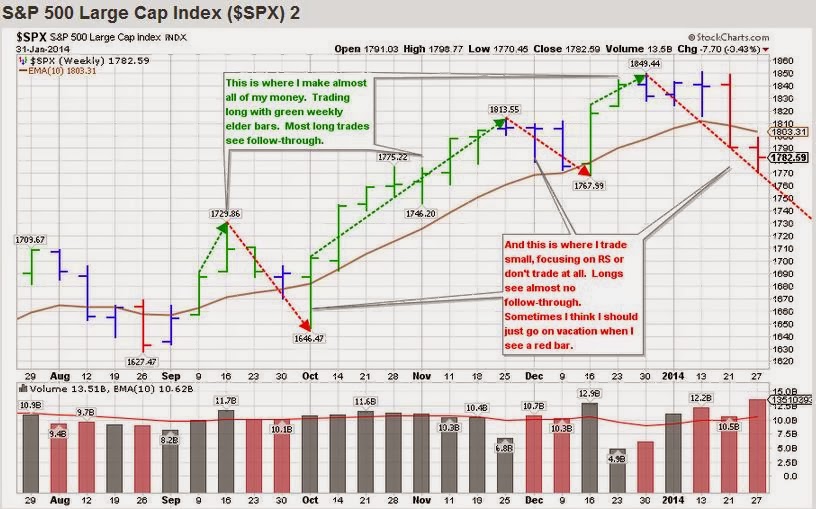
With apologies to Dr. Seuss, here's a chart which nicely summarizes my trade history:

I'm mainly a long trader, but I will occasionally take the right set-up in some of the triple short index ETFs.  However, that's still "long" a short fund.  It's just what seems to work for me right now.  2013 was really tough for shorts (at least for me vs. the indexes).  You had to be very quick in recognizing the turn, scale some profits, raise your stop and make sure you didn't give it all back when the indexes gapped up on Tuesday or Friday.  As the "Bill the Cat" cartoon likes to say, "ACk!".  I was lucky to scrape out a few pennies on more than one occasion last year.

Here's a short set-up that I'm watching in SCO:


Given my preference to trade on the long side, I tend to make most of money when the $SPX has green weekly elder bars and is trending up.  The trend might last 2 weeks or 10 weeks or more.  Sometimes I can squeeze another week of decent profits out at the top by focusing on relative strength in individual stocks while we trend sideways in the $SPX.  I need to get better at pressing harder during these periods - in any case, this is where I make my money.

On the flip side, when the $SPX is slipping down with blue or red elder bars - it's a struggle for me to trade on the long side.  Most of my long trades see no follow-through at all.  Therefore, I trade small or not at all.  For example, this week I saw some relative strength divergences in ETFs like:  IWO, IWC, IJH, MDY, XLF, FAS, TAN, and IBB - all of which failed to make a lower low on Wednesday and bounced sharply on Thursday.  You had to be quick in identifying that trade, taking profits, and raising stops or you gave back some profits on Friday.  My trades here are mainly short-term rentals which need lots of attention and quick fingers.  Another option is to take long set-ups in the double and triple short ETFs if I see low risk entries (like SCO above).


So, here's the question that I'm thinking about right now:  Is it worth it?

The way I see it, there's 4 options while the market is sliding downwards:
1.  Sit in cash and watch from the sidelines.  Kind of boring, but also a good time to reflect + spend more family time (which is also very valuable).
2.  Try to catch small bounces on the long side.  Reminds me of jumping in front of a bus to pick up a penny.
3.  Short a market that's basically crushed shorts since summer of 2011.  One of these times it's going to work, but that same logic can cause drawdowns.
4.  Some hybrid of the above.

Right now, I'm feeling like doing some hybrid of the 3 options.  I don't want to lose touch with the markets, but I also have no interest in losing the money that I make during uptrends.

So, that's my plan:  trade small, keep lots of cash, hang out with my daughter, and wait for the eventual turn and for green bars to come back!

For more charts (and less words), see my public chart list on stockcharts.com:
http://stockcharts.com/public/1109955

Sunday, January 26, 2014

January 26th 2014: Stock market bottoms are like pornography...

....I'll know it when I see them.  Probably.

Everyone wants to know where the bottom is in the stock market indexes because we dropped a few percent off of all time highs.  Right off the bat, I'll say that I have no idea where or when the market will form a bottom.  Some of it depends on your time frame, but for this post - let's define a trade-able bottom as being on the daily bar chart time frame that retraces at least 25% of the eventual loss from $SPX 1850.

Again, I have no idea where on when the market will form a bottom, BUT I do know what to look for.

Bottoms can come in all shapes and sizes - especially the stock market variety.

Here's what they usually don't look like:

Here's what that chart looks like to me (a falling knife):

Secondary indicators like big black bars showing up on a heikin-ashi $SPXA50R at oversold lows or $VIX>20 can be very helpful:


But in the end, I always defer to a price chart.  Here are some recent examples of what a bottom in the $SPX looks like to me:

Will the eventual bottom look like one of these 3 patterns?  Possibly.  We could also have a "tweezer type" bottom (which I personally dislike to trade). We could do something completely different and I'd probably miss the bottom in the indexes and just trade individual stocks (which is fine with me).   The important part is that I'll be looking for some reversal or exhaustion type pattern which I can trade with defined risk + better than random probability.

One final thought:


Good luck out there next week.

For lots more charts (and less commentary), check out my public chart list on stockcharts.com.
http://stockcharts.com/public/1109955